
How do I even automate savings from each pay?
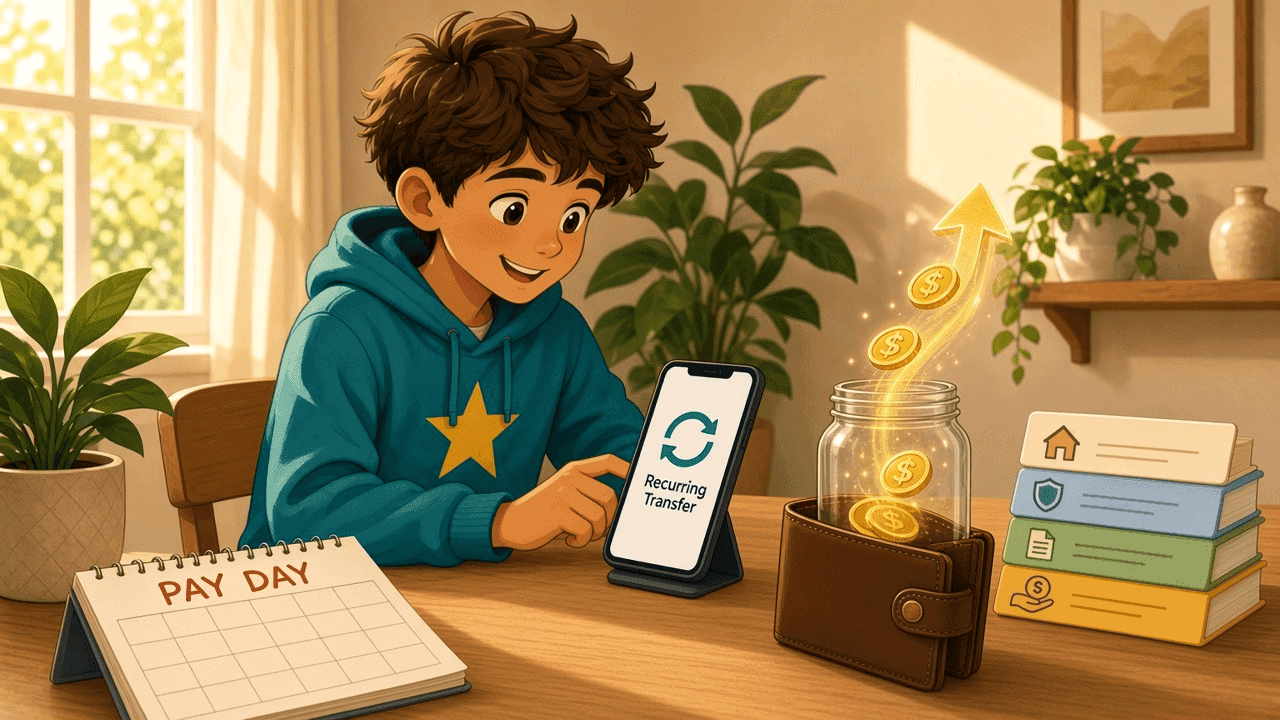
A payday transfer so the intentional slice leaves before the week spends itself. Start small.
Automating savings means setting up a transfer that moves a planned amount from your everyday account into savings when (or right after) you get paid, so the intentional slice leaves before the week’s spending starts. You’re not waiting to see what’s left on Sunday; the plan runs first.
Why payday timing matters
When pay hits and everything sits in one account, it’s easy to spend the holiday drip without meaning to. A same-day or next-day auto transfer treats savings like a bill you’ve already agreed to pay yourself. Same idea as What even is “pay yourself first”?.
That’s the whole trick: planned slice first, live on what’s left on purpose including Friday with mates and the fun you’ve actually budgeted.
Emergency vs savings vs investing. Separate autos if useful
These jobs aren’t the same:
- Emergency. Cash for unknown surprises
- Savings: named goals and sinking funds (rego, holiday, Christmas)
- Investing. A separate slice only when you’re ready for that path
If it helps, set more than one auto: $X to emergency, $Y to a holiday pot, maybe $Z to investing later. Or one transfer into savings, then you split manually. Either works. Clarity beats one vague “future” sweep. Buffer: What even is an emergency fund?. Named pots: What even is a sinking fund?.
Start small (seriously)
New to this? Automate an amount that won’t wreck the fortnight. Five or ten percent of pay (or a flat $20 / $50) is enough to prove the system. You can bump it when the plan feels steady. Starting tiny and actually running beats a heroic number you cancel in week three.
Fit the number to your rent/board, hours, and life. There’s no universal percentage that makes you a good person. First split: How do I even split my first pay?.
How to set it up (generic steps)
- Know your pay day and amount (or average, if shifts vary)
- Pick the intentional slice(s) and destination account(s)
- In your banking app, create a recurring transfer for that day
- Leave enough in everyday for Housing, food, transport, and planned living
- Check it once after the first pay cycle. Then trust it
If your pay is irregular, automate a safe minimum and top up manually on bigger fortnights. A common destination: What even is a high-interest savings account?.
Still live inside the plan
Automation isn’t punishment. It’s removing willpower from a decision you already made. The social plans stay; they just sit in the living line instead of accidentally eating the car fund.
Once the autos exist, a view like DoshHero Budget helps you confirm the slices match your real pay and bills, so “set and forget” still matches the life you’re actually living.
See also
What even is “pay yourself first”? · What even is a high-interest savings account? · How do I even split my first pay? · What even is an emergency fund? · How do I even save for a car or holiday?
More in Budget
- What even is a budget?
- How do I even split my first pay?
- What even is net worth?
- What even is an emergency fund?
- Set up the DoshHero Budget
- Your first real budget (the three buckets)
- Sinking funds without the spreadsheet stress
- Living now while setting up later
- What even is a sinking fund?
- How do I even set up my first bank accounts?
- What even is car insurance?
- How do I even budget while living at home?
- How do I even budget when I rent with mates?
- What even is a high-interest savings account?
- How do I even save for a car or holiday?
- How do I even set money goals that stick?
- What even is contents insurance?
- How do I even pick an everyday bank account?
- What even is inflation?
- How do I even build an emergency fund?
- How do I even save for Christmas (and birthdays) without the January hangover?
- How much of my pay should I actually save?
- How much board should I pay my parents?
- Am I behind? Savings and net worth at 20 and 25
- How do I even buy my first car without a loan wrecking me?
Dosh Drop